


Release notes
Loading release notes…
That extra scroll, the late-night snack, one more drink. They feel harmless in the moment. Habits have a tipping point. Most people miss it until they're past it.
You don't need to quit. You need a budget.
Set your personal limit. Open the app when you slip. Stay under your
number and the biology stays on your side.
Set limits on the habits
you keep
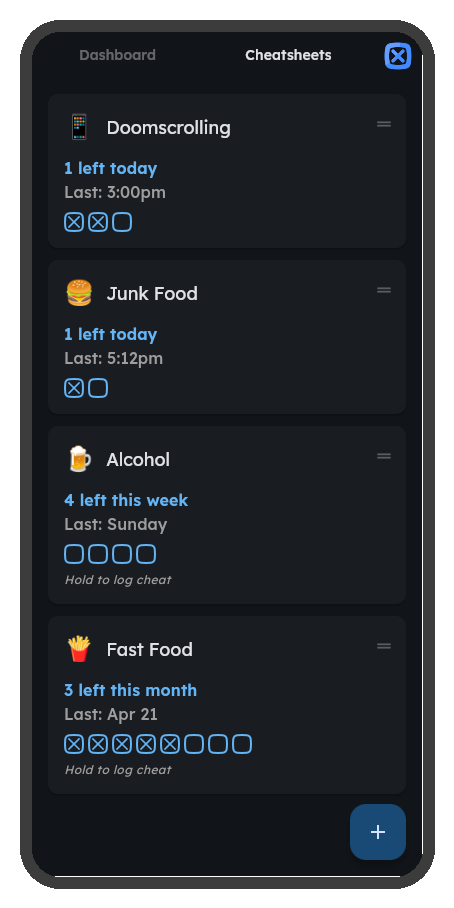
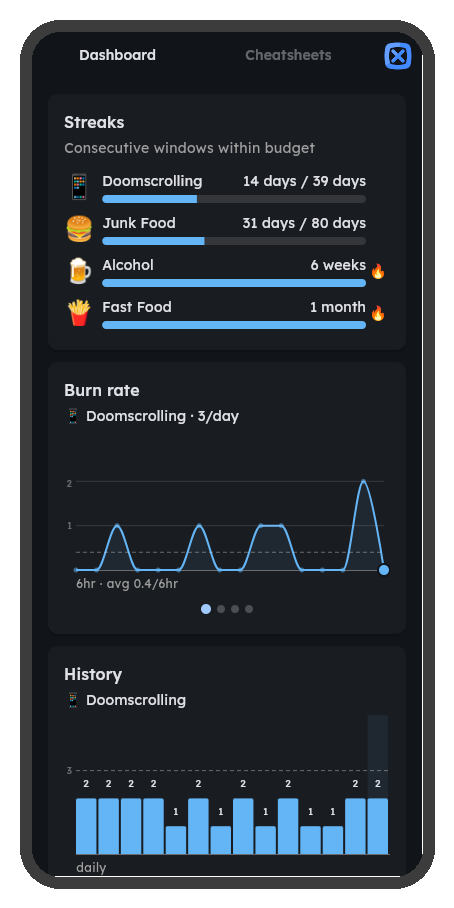
Streaks, budgets, and
progress in one view
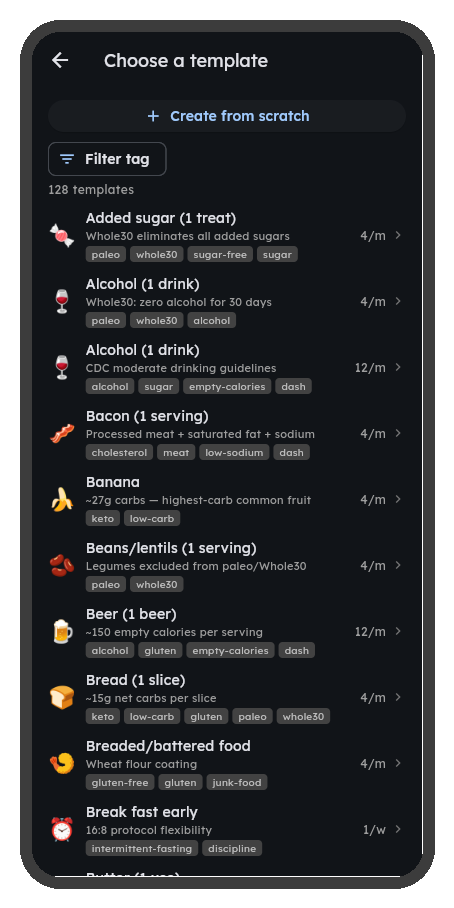
Start from 120+ templates.
Or build your own
Most people think quitting entirely is the only way. Abstinence goals backfire. One slip triggers shame and full relapse. Moderation with self-awareness delivers the same results. Tracking each slip alone changes the behavior.
Quitting cold turkey makes it worse. The Abstinence Violation Effect describes strict zero-tolerance goals. One slip triggers shame and full relapse. Budgeted moderation stops this spiral before it starts.
Alcohol thresholds are well defined. The NIAAA sets weekly and per-occasion drink counts. Above them, dependence risk rises sharply. Drinkers within moderate limits face a 2-in-100 chance of alcohol use disorder.
Moderation produces the same outcomes and fewer dropouts. A meta-analysis of 22 studies found no significant difference between moderation and abstinence treatment. At two years, moderation outperformed abstinence. People with moderation goals stayed in treatment longer.
People control bad habits by self-monitoring. Vigilant self-monitoring overrides habitual behavior. It works better than willpower alone.
Quinn et al., Personality & Social Psychology Bulletin, 2010
Awareness alone changes how the brain values a behavior. Observing your experience during an unwanted behavior rewrites its value. Change follows without willpower or force.
Ludwig, Brown & Brewer, Perspectives on Psychological Science, 2020
Everyday behavioral addictions are clinically real. Gambling, internet use, gaming, eating, and shopping engage the same reward circuitry as substance dependence. They produce the same compulsive patterns.
Questions or issues? Email us. We reply.
[email protected]